

On a night in Berixike Township, Yecheng County, Kashgar, Xinjiang, a special “Mandarin Promotion Evening” was broadcast live via Douyin to audiences far and wide. On the screen, college students and villagers sang adapted folk songs together in Mandarin, while comments such as “beautiful” and “I’ve learned it” scrolled continuously across the screen.
This is a typical scene of the college’s “Voice for Rural Vitalization” Mandarin popularization practice. For five years, our faculty and students have traveled across mountains and rivers, entering more than 20 remote ethnic minority areas, and have built a sustainable system integrating promotion, practice, and education using a “five‑step language empowerment method”.
Connecting Local Communities to the World, Injecting “New Voices” into Development
“We are not just teaching a language; we are awakening the confidence to express oneself”, said team leader and faculty member Huang Jing. In Shazhou Village, Rucheng County, the team tailored “livestreaming script training” for returning youth, helping them progress from being “afraid to open their mouths” to livestreaming fluently, thereby boosting local yellow peach sales by 30%. In Yongshun, western Hunan, students produced short videos of dialect nursery rhymes, allowing fading local voices to be heard again through new media.
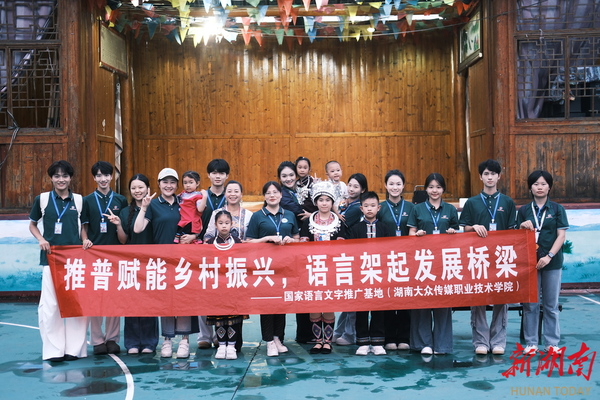
This practice forms a closed loop through five steps: “preliminary survey – tiered training – cultural and creative transformation – converged media dissemination – long‑term evaluation”. The team precisely targets different groups: offering language expression improvement training for teachers, designing e‑commerce livestreaming courses for returning youth, and developing fun Mandarin classes for left‑behind children. Over the past five years, the team has established 12 practice bases nationwide, delivering a total of more than 20,000 person‑times of “language + skills” training and cultural services. The average Mandarin proficiency of participating villagers has increased by 1.2 levels, and 85% of them can now use Mandarin for daily communication and e‑commerce livestreaming.
The “language +” integration has become a distinctive feature. Leveraging their media expertise, students have created bilingual nursery rhymes (dialect + Mandarin), audio dramas of revolutionary stories, and short videos promoting agricultural products, transforming local cultural resources into communicable IPs. In places such as Yecheng County in Kashgar, Xinjiang, and Shazhou Village in Rucheng County, Hunan, villagers have participated in e‑commerce livestreaming training, leading to an average 30% increase in sales of agricultural products such as walnuts, yellow peaches, and nai plum, thus achieving a virtuous cycle of “language empowerment – cultural value addition – economic development”.
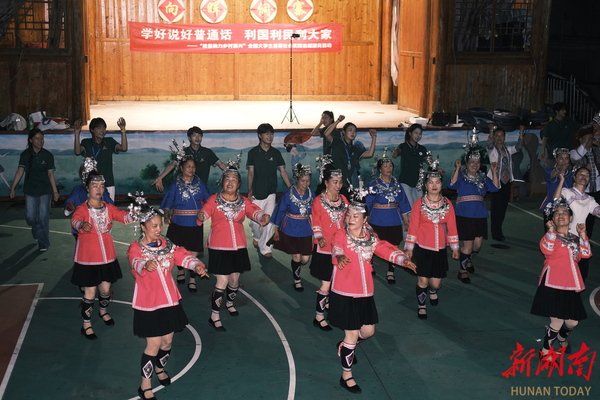
Growth and Responsibility Cultivated in the “Classroom on the Move”
For students, this is a “itinerant professional course”. As they immerse themselves in rural areas, they use cameras to document dialects, editing software to produce cultural tourism short videos, and new media to disseminate rural stories. As one student wrote in a practice diary: “While teaching children broadcasting and hosting, we also experienced the joy of learning through teaching”. In the past five years, participating students have won more than 100 awards in various competitions at all levels, including a “zero‑to-one breakthrough” in national competitions. Even more profound is the shaping of values – more than ten graduates have chosen to work in grassroots language services, integrating their personal growth into societal needs.
This practice has also become a vivid vehicle for ideological and political education. In 2023 and 2024, the team was successively recognized as an outstanding service team in the summer “Three Journeys to the Countryside” social practice activities for college students in Hunan Province. In 2025, it was honored by the Ministry of Education and the Central Committee of the Communist Youth League as an outstanding team in the national college student summer social volunteer service activity “Promoting Mandarin to Boost Rural Revitalization”. “We are not helpers, but learners and companions”, the team members said. The deep engagement with local communities has honed students’ sense of social responsibility and patriotism, achieving the educational result of “cultivating talents through skills and forging character through action”.
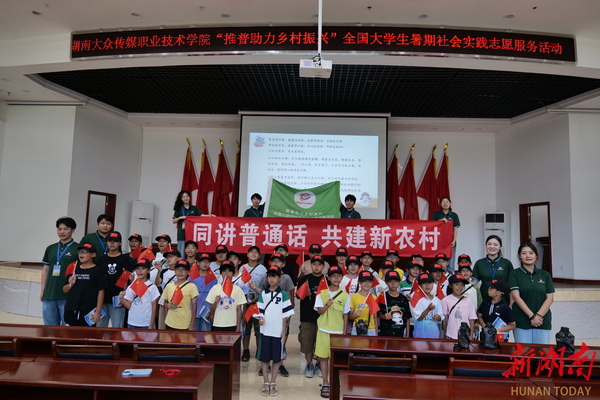
Owing to these remarkable outcomes, the college was awarded the title of “Advanced Collective for the Popularization of the National Common Language and Script” by the Ministry of Education and the National Language Commission in 2023, and was approved as a “National Language Promotion Base”, becoming the only institution of higher learning in Hunan Province to receive both honors. This model has been adopted by many other institutions, and “Voice for Rural Vitalization” has become a regional brand project for Mandarin popularization practice.
Today, the college is planning to further expand its practice network and to establish a “Rural Language Cloud Platform”, advancing language assistance toward intelligence and normalization. A path to rural revitalization, using language as a bridge and practice as the way, is now stretching ahead.
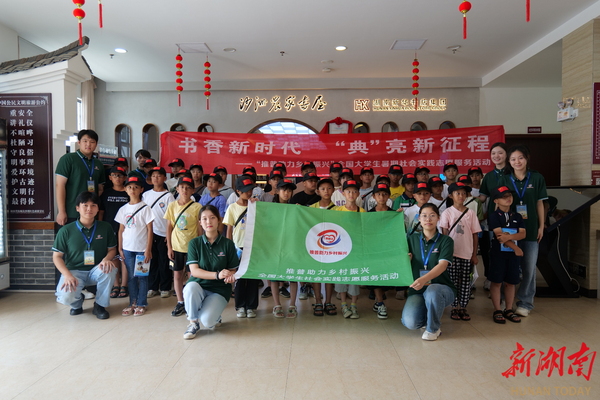
Source: Hunan Daily Omnimedia

